Showing posts with label cotton spinning. Show all posts

Thursday, February 13, 2014

In the Land O'Cotton

My friend Laurie has been learning to spin cotton.  She’s been texting me photos and descriptions of her progress.  I’ve got more than a few projects going on, including a final curtain valance for the living room windows.  (It’s going to be a thistle pattern, a nod to my love for Scotland.)

Just the mention of cotton, however, sucked me back into the land of cotton.  I just couldn’t stay away so I dug out my ongoing cotton spinning project (ongoing because cotton lasts FOREVER) and went to work. 


The small ball is a singles of about 300 yards of cotton, I would estimate.  The ball being wound from the 2 spindles is probably another 150 yards at least – as a 2-ply, of course.  I can’t wait to wind this cotton off so I can spin another singles to match the ball and get it all plied.  Will that be enough cotton spun?

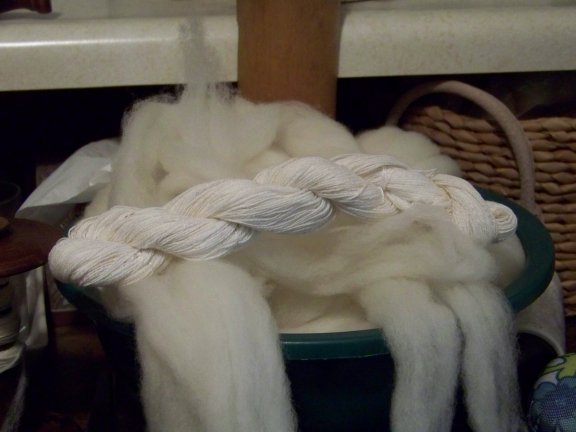
I mentioned this was an ongoing project.  This is a skein I spun earlier.  I have another 2-3 larger skeins floating around here somewhere, one spun from tri-color natural-colored cotton.  The goal was to spin enough to knit something but I haven’t figured out yet what would be best to knit.

Saturday, September 22, 2012

Diggin' the Cotton

I've been on a cotton bender lately.  A few weeks ago I demo-ed at a friends booth at an event and, once again, people were fascinated by the magic of cotton.  To me, that's the only word to use.  There is something so magical about how this stuff grows (the flowers change colors and the seeds burst their bolls), how it comes right off the seed and how it spins up.  It was very satisfying to have women and men stand by me watching it all happen and being as entranced as I am.  It's like we were all just standing back watching a wonder of nature unfold right before our eyes.
I was going to use this cotton in a particular baby item but found that the thread is not suited to the technique I was going to use so I'll need to figure out something else to do with it.  For anyone who has never felt handspun cotton and who only knows cotton as that heavy or rough stuff that usually comes from commercially produced yarn or thread, they would be even more amazed at how light and soft and cushy this stuff is.

On a more wooly note, remember the Polworth yarn I was unhappy with?  Here's what happened to it:
Still no better spun but as pretty as can be.  This is the advantage to the Navajo plying and keeping the colors pure.  You get great striping like this.  I'm the most pleased at the scarf and how perfectly these vintage buttons matched the yarn.

The scarf pattern is very simple.  I cast on about 24 stitches and worked K2, P2 ribbing until I almost ran out of yarn then I crocheted the edge, including 3 loops for the buttons.  I attached the buttons at an angle so it would sit right when around the neck.  Easy, peasy.

Saturday, March 24, 2012

Too much fun

To answer the question of if you can have too much fun, I think I would definitely say, "Yes!" 
I just finished 3 hours of demonstrating cotton spinning. It was not 700 kids (thank goodness) but it was a steady flow of kids and their parents for 3 hours. I would estimate 150-200 kids although some of them felt like 700 kids all by themselves!! 
But it was so much fun to watch them as I explained that their jeans and cotton tees started out as the little fluff of cotton they were holding. They each got a cotton seed and I'd started a couple growing last weekend that were an inch or so tall. So I think there are going to be lots of cotton plants in Springfield this summer. 
Here's what my booth looked like:
(edited to fix pictures)

Thursday, March 22, 2012

Ready or not. Mostly not.

On Saturday morning I will be participating in a family art fair that organizers hope will attract 700 kids. I will be demonstrating spinning cotton and will have cotton seeds the kids can try to spin from and then plant if they want.  This is Thursday night.

This is where I'm at in preparing my display:

So there can be no doubt as to how my Friday night will be spent.


Thursday, February 2, 2012

Try, try again

This post is mostly about not giving up on things when they don't go right the first time.  Or the second time.  Or the... (you get the idea).

When I first started trying to spin with a tahkli spindle, it was a miserable failure.  So I put it away and decided that the tahkli spindle wasn't for me.  Part of the problem was not being able to do the long draw very well and part of it was managing the spinning of the spindle.

The next time I tried it, I at least got some yarn made but it wasn't very good.  In fact, I threw it away because it was so bad.

Then I've tried it several other times when I was trying to show people how it worked (in theory because I did more 'splainin' that spinnin').

In all my classes, I always tell people they have permission to suck at whatever they're learning because they don't know how to do it.  It's like Captain Picard said, "Things are only impossible until they're not."  Once they're not impossible (because we've invested some time in them) then they're possible.  N'est pas?

Recently I've been working with the beautiful support spindles my friend made for me and some angora fiber that I'd had in my stash for a while.  Like this, for example.  Working with this fiber and these spindles has helped me heaps in learning how to prepare my fiber and how to keep the spindle under control.

So the other day I got an email from a local teacher asking me to be involved in an arts day they're planning for local school kids.  I'd taken part in a program they did a couple of years ago at a local school and had a blast.  Now she's got some grant money and wants to "go big" with a Saturday gig at the Hoogeland Center for the Arts for kids from a lot of different schools.

I was thinking how fun it would be to do something with cotton since it's definitely something they can relate to and I have plenty that I can let the kids have a cotton seed and see it in the boll, on the seed, spun into yarn, and made into something.  It's educational and yet fun.  Of course that sparked me to pull out and dust off the old tahkli and give it another try.  I predrafted and opened up the fibers like I'd been doing with the angora and started to spin. 

It was like magic - it suddenly all came together in my brain and my hands and this is what happened:
 Over a couple of evenings (and early mornings), I spun a section about the size of the raw cotton on the right of the photo and got what's on the spindle.  Cotton goes unbelievably far.  I plied just a little strip of the yarn as a sample (which you can see in the middle).  The comparison sample is some size 12 perle cotton (on the far left).  Here's a photo to show the comparison of the two:
It has spun so fine and I swear to you it was all by magic.  Who said I couldn't do this?  I can totally do this!  If I play my cards right, this might be the perfect handspun cotton to knit a doily with.  I love it when a plan comes together....bwahahahahaha.

Monday, September 5, 2011

Plenty o' Cotton

I've finally gotten a chance to spin some of the cotton my Mom grew for me last year.  I keep saying that it's pretty astounding to see how much cotton fiber is on one little bitty cotton seed.  I spun a handfun (about 200 seeds) of the homegrown cotton.  Have a look at this:
This is the 2-ply skein of about 175 yards of cotton and the seeds it came from.  Since it was about 200 seeds, that means, on average, there was almost 2 yards of fiber on each seed.  Granted that this has be spun pretty finely but still. 

The other interesting thing about this cotton is how much silkier it was than the commercial stuff.  I tried to get a photo that would show how silky it looked but I just couldn't get it to show up.  This stuff was silky and bright white.

This is the cotton up against the while cormo that's waiting to be spun.  I hope the color shows up on the screen.  LOVE IT.

Friday, August 12, 2011

If Fiber Were Liquor

This would be smooth 12 year old Scotch.

Since I don't drink, fiber becomes the stress reliever of choice.  Last weekend, in an effort to deal with work stress, I started on this tri-color organic, naturally-colored cotton.  The previous picture was prior to washing and this is what it looked like after it got boiled with the washing soda:
The difference in color is more about how the cotton darkens after it's washing that about the difference in photo lighting.  250 yards of smooshy, cushy cotton.  Hummm...now, what can I make with it?

While I was busy spinning the cotton, there was something busy spinning other things around here:
Yep, and it was really as big as it looks. 


Saturday, January 8, 2011

New Video

I just wrote a whole post that disappeared when I was trying to post it.  Never mind.  Here we go again.

I've just posted a new video on spinning cotton from the seed so give it a look.  Here's the link.  It came out of a program I've been preparing for the Prairie Weaver's group this coming Tuesday.  I thought this would be a fun way to have a follow up for those who want to go back and practice spinning from the seed (which, by the way, is my favorite way to spin cotton).

I also wanted to remind you that if you've ever wanted to try out spinning with a drop spindle and are in the Central Illinois area, be sure to sign up for my class at the Lincoln Land "Needle in a Haystack" event on January 15th.  There's still some room in the class.  You'll be able to put together your own spindle, learn the basics of handling fiber and get started spinning.  Although the class is a little over an hour, I'll be around all day in the demonstration area and you can bring your stuff over and we'll spin all day.  Here's a link to more information about the day and how to get registered.  There are lots of other classes, too.  Hope to see you there.

Saturday, July 10, 2010

Sampling

In keeping with my goal to sample with fibers and spinning and such, I had a good time this morning.  I plopped in my "Roman Holiday" dvd, got my variety of fibers I'd put by to sample with and my cards and had a good old time.  First of all, how could you not have a wonderful time with Gregory Peck and Audrey Hepburn.  I LOVE that movie.  So sweet and bittersweet.  Always brings a little tear to my eye when they meet in the middle of all those reporters at the end.  Sigh...  Love that movie.

Gregory Peck, Audrey Hepburn and surrounded by scrumptious fibers.  Nothing better. 

For this morning, I just wanted to see how the fibers acted together.  I had corriedale, generic wool top, merino, silk noils, tussah silk, bamboo and tencel.  I loaded my cards with a little of this and a little of that, mixing them as seemed good, adding colors as it seemed good.  Once I had the fibers carded lightly and rolled them into a rolag, I spun them on my Ashford drop spindle and plied them Andean style to get a good 2-ply sample skein.

These were straight off the spindle and these are after they've been washed.  I don't know if you can see the difference in these pictures but they really "bloom" after they've been washed.  As always, you can click on the pictures to see a larger view.

I enjoyed myself immensely, not only because it was fun to figure out how much of each color and each fiber to load up and, of course, I always love the wow factor of how the yarn looks as it is spun into singles and then plied into a yarn.  It always seems a little magical to me and never quite predictable.  I like that!

My exploration of cotton continues, too, with this little wrap of tri-colored natural cotton that I've had for ages.  You can see the top and then how the color deepens once the yarn has been boiled good and proper.  Our spinning group took to the park the other night and I took my "coyote" cotton (that's the reddish/brown color) top and I spun and I spun.  I told some of the ladies that I never ever thought I would fall in love so deeply with spinning cotton.  I just can't get enough of it.  I realize that much of that has to do with the preparation of that particular top that makes it so easy to spin.  Believe it or not, I love cotton.  Next time I'll let you in on the little experiement in cotton my Mom and I have going.  Actually, she's done all the work to this point!

Wednesday, June 30, 2010

Way down yonder, in the land of cotton...

COTTON UPDATE

I would like to report that the cotton jag has not lifted, even though it was interrupted for a few days with the retreat.  I'm finally feeling like I'm getting the hang of the spinning of the cotton although I'm still having trouble with the regularity of that spinning, i.e. the unevenness of it all.

However, I got impatient last night.  I had one prety full bobbin (ok, it was half full but with another half full bobbin, it would have been a full bobbin when it was plied) and had started on the second one.  I kept thinking, "I wonder what this is going to look like.  I wonder if this is going to work. Hummmmm...." until I could stand it no more.  I whipped off the partially filled bobbin and whipped on a new bobbin for plying (I really did whip them off and on - I was curious) and got to gettin'.

Here's what I got.  About 248 yards of cotton.  Real. Cotton.  I mean, can you believe it?  There were a couple of places where it came apart so I had to knot it but for my first real go at a skein of spun cotton, I don't think that's too bad.  It came out fairly fine but you can see that it's not very even but it'll do until something better comes along!

I'm now trying to plot what sort of summer top I'm going to make.  This should get me some distance down the line in making something before the end of the summer.

I should mention that it's only 1 1/4 ounces or 36 grams.  Raw cotton is much, much lighter than the commercially spun yarn one finds.  I suspect that's to do with making something that will take a lot of wear (commercial) as opposed to what I've done.  But it's like air.  Most unexpected.

Once I got the hank spun and onto the niddy noddy, I tied 4 ties around it to prepare it for the boiling.  With this kind of cotton, boiling helps set the twist and helps clean off the naturally forming substances that you don't want in your finished yarn.  Some gunk came off but not a whole heck of a lot and the color did deepen a little but not as much as I'd expected.  Not to worry.  I've got me 248 yards of my very own handspun cotton yarn!


Tuesday, June 15, 2010

Cotton Country

Boy, it's hard to believe it's almost here.  The Heritage Knitting Retreat.  Jane and I have been working for 2 years for this weekend and we're more than excited.  If you can still join us, please let me know.  If you're not able to join us, we've developed a workbook and companion cd that will be available for purchase. 

In the midst of everything else, I've been bitten by the cotton bug.  It's causing a little bit of distraction.  I think we're going to get there but it's definitely a distraction.

I started with this dyed cotton from the Woolery:

As you can see, I haven't gotten much further with this cotton, mostly because I got drawn into this cotton:


This is organic cotton which is naturally colored.  It actually grows this color, commonly called coyote.  The interesting thing about this cotton is that, once it's spun up and boiled (to get the natural goo off), it will be a darker color.  It's doesn't go quite brown but it's definitely towards that color.


This is this almost 1 ounce spun on my Fricke using the fastest whorl using my version of a long draw.


And this will be my next project, tri-colored cotton, all naturally colored.  But it will have to wait until after the weekend!


Edited because I completely forgot to show you this.  My mother, who can grow anything on God's green earth, accepted the challenge to try to grow some cotton plants from seed I spun from.  Here's her little babies:

Monday, June 7, 2010

Not for lack of trying

I got some pictures taken finally yesterday and tried to get them posted but there was some problem with Blogger. 

While I was working on some stuff yesterday, I was watching some old movies.  One of them was a really weird movie called, "The Villain Still Pursued Her."  Came out in 1940 with people like Alan Mowbray, Buster Keaton, and Margaret Hamilton (the wicked witch from the Wizard of Oz movie).  If you click on the link above, you'll see a plot description but the better description is at the bottom of the page with the User Review.  This is a satire on the melodramatic dramas out there and is so bad that it's hysterical - by the way, it's bad on purpose.  Basically, every moment that could be overacted is overacted and every contrivance is used, all the way from the beginning of the movie which finds a newly widowed mother and her beautiful daughter discussing how their husband/father had left them with little money and the mortgage is coming due.  The slimey lawyer tries to convince them that the land owner is going to kick them out.  In reality, he is trying to get the beautiful daughter to marry him.  Fast forward to the daughter finding out that the handsome young land owner is kind and marries him.  On the wedding day, the young man declares that he never drinks and the new young wife says, that's great because no lips that have touched the demon liquor will ever touch my lips.  The lawyer realizes this is his in and tricks the young man into taking a drink, which turns him into a raging alcoholic.  And it continues from there.   Definitely worth a viewing if you're up for a laugh.

In getting ready for the Heritage Knitting Retreat, I decided I should probably get my silk beaded purse finished.  This is one of those projects that started out just to try out how the Gudebrod silk would work in a 19th century reproduction purse that would have originally used silk thread.  I learned a lot experimenting with the materials for this project.  Things like sizing for silk thread.  A is small, FFF is large (FFF is like smaller fingering weight).  "A" is thin, like thread thin, really thin.
I love the feel of the silk with the beads and would highly recommend you trying it if you have any desire to knit a beaded purse.  The thread is softer than mercerized cotton and accommodates the beads much more easily, although it will go a little hinky if it snags on a bead.  It only happend to me once and I used almost an entire tube of 11/0 beads.  It wasn't too bad, just not something that happens with the mercerized cotton. 

I've been working for quite a while on spinning a truely lace-weight yarn out of some Blue-faced Leicester.  It was my first project on my Fricke wheel and it's been a whole lot of spinning.  A.Whole.Lot.of.Spinning.  Now part of this roving has been spun on my Ashford drop spindle (which I've currently lost sight of - I know it's here somewhere) but the majority of it has been worked on the wheel.  I have no idea what the yardage is going to be but I suspect it's going to be in the neighborhood of about 1,200 yards.  1,200 yards is actually 2,400 yards plus plying so it's really 3,600 yards of spinning.  Like I said, a bunch of spinning. 
It's also been quite the learning experience.  Even though BFL is a longer stapled wool, when you're spinning this finely, it takes a whole lot more twist in the singles than you realize.  I've hit patches where I obviously didn't have enough twist in the singles.  It would be interesting to know what happened during those periods of spinning to make me not be paying enough attention. 


I haven't posted anything yet about the cotton roving I bought from the Woolery booth in Lexington.  The color is called Terra Cotta.  It's dyed, not one of the natural colors, but I'm thinking I may ply it with the natural coyote color.  The natural colors darken when you finish them and I think it might look nice with this.  I've been spinning this on the fastest whorl of my Kromski Minstrel using my own modified version of the long draw.  I find this modified version to be much easier to control than a proper long draw.  I'm sure it's just because I haven't practiced enough with it but this seems to work fine for what I'm doing.  Here's the start of the bobbin.  I'm not spinning it super, super fine but it should work out to a heavier lace weight sort of yarn.  I'm wondering if I can actually get enough spun for a summer top before it gets cold again.  That's my challenge, should I choose to accept it.  And will I accept it?  I'll let you know along about September time : ).

Thursday, May 13, 2010

Time for Heritage Knitting

Time is getting close for the Heritage Knitting Retreat in Petersburg, IL, in June.  If you've been interested in the the retreat, you'll want to get your registration in soon.  We've got a very full, very fun program planned so come join us.  You can find more information and a downloadable registration form at the link above.

Lest you think all I've been doing is crocheting, I wanted to post some pictures of a spinning project I've also got going. 


It's Blue-faced Leicester roving hand dyed by frabjous fibers in Vermont.  The colorway is Potash.  This is the second batch I've spun from frabjous fibers - beautiful colors and spins like a dream.  Boy, that link is dangerous.  I got a little lost there - but I'm back now.

I'm spinning part of it on my new Fricke spinning wheel.


Since I haven't had time to share some pictures of my wonderful new wheel, here's a view of the whorls.  Very industrial, right?  I like it.


And that's a view from the front.

And part of the fiber, I'm spinning on my Ashford drop spindle. 


Of all the spindles I've got, I always go back to my Ashfords.  My very first spindle, and in fact my very first contact with fiber, was with an Ashford drop spindle.  I always go back to it.

I can't tell you how much I love this fiber.  I saw it and immediately could visualize a shawl.  I wanted to do the test to see how different the yarn would come out depending on the method of spinning.  As you can see, I've got one bobbin done with the spindle; with the wheel, I've almost finished the first bobbin and will start on the second bobbin. 

In case you're wondering where I got the bobbin, it's a noodle bobbin.  Noodle, you know the things you use in the pool?  Cost a couple of bucks?  They make great bobbins - just cut them to length and trim down the middle.  It already has a hole in the middle for the lazy kate so it's ideal for storage and plying.  And that's our top tip for the day.

Thursday, January 28, 2010

You can always count on socks

I love knitting socks.  Plain socks, lacy socks, any socks.  I love knitting socks.  I love them because they're so easy to take with you anywhere, they're useful, they're pretty.  Just when you're discouraged because it seems like nothing is getting finished, not afghans or tablecloths or cotton spinning or lace spinning, they will allow themselves to be finished.

I'll get the pattern posted at some point but the down and dirty pattern is this:
I used Berroco Ultra Alpaca Fine in an oatmeal color.  I cast on 64 stitches using US size 2 double pointed needles.  Do K2/P2 ribbing for 2.5 inches then start the pattern as follows:

Round 1: *K4, P1, K2, P1* repeat around.
Round 2: *Yarn over (yo), knit 2 together (K2tog), K2, P1, 2 stitch cable, P1* repeat around.
Round 3: Repeat round 1.
Round 4: *K1, yo, K2tog, K1, P1, 2 stitch cable, P1* repeat around
Round 5: Repeat round 1.
Round 6: *K2, yo, K2tog, P1, 2 stitch cable, P1* repeat around
Round 7: Repeat round 1.

Rounds 2-7 make up the stitch pattern.  Make the cuff as long as you want it to be - mine was 8 pattern repeats.  Work heel.  I worked 9 more repeats for the foot (17 repeats in total from top) but I've got a small foot.  I worked the toe decreases kniting the whole thing in stockinette.

If you've never worked a heel or toe, grab any pattern because it's basically the same for all of them.

I've spun the fiber of 109 seeds.  Here's a gratuitous shot of my cotton bobbin:

Tuesday, August 25, 2009

Handspun Ella

I will be making a visit home to Texas soon and while there my Mom and I are hoping to make a side trip to her home town, Rotan. Rotan is in Fisher County, the heart of cotton country and I want straight from the field cotton. I've been looking forward to this trip ever since the Spring when we had the cotton spinning workshop. I had a call with a very nice lady at the cotton gin who told me that the crop was going to be late this year but that we would be welcome to come and tour the gin and see how everything gets processed.

In preparation, I thought it would be a good idea to go back to some cotton and see if I remembered how to spin it. It's not necessarily pretty but I managed to spin about 65 yards of 2-ply Upland cotton yarn. I wasn't sure how much yardage would be needed for a doily and I didn't want to run out in the middle so I found the smallest knitted doily I could find! Here's what it looks like worked into the Ella pattern from Gloria Penning's "Danish Lace Treasures."


One thing I learned while spinning this, and I think I got better as it went along, is the rhythm of the long draw with cotton. When you draw your hand back, there can be slubs. You don't want to be in too big a hurry to draw these slubs out. That's where you get the thick and thin that doesn't ever want to thin out. You have to draw your hand back and let some twist go into the fiber, then you can draw it back a little further, let more twist in, draw a little further. It seems counter-intuitive but the more twist you add, the more it stabilizes those thicker slubs so when you draft it out further, there's something there to hold it together.

The thing I struggle with most in long draw is making sure that I have enough twist in the yarn before it feeds onto the bobbin. So this time I made my initial draw back shorter so there was less to work with on each draw then before I let it wind onto the bobbin, I pinched the yarn with my forward hand just a few inches away from the orifice and with my back hand just before the unspun fiber and gently pulled. When there wasn't enough twist I could fee the unstability because it would let me pull my hands apart. When there was enough twist, I could easily feel that it was solid and was ready to go. It really is about teaching your sense of touch to know when the yarn is stable. I still need a lot of practice but I'm feeling better about it.

Wednesday, April 22, 2009

Last night at the spin-in I got 2 more of the samples spun up - the acala, which is one of the shorter cotton fibers, and the Egyptian, which I think is sort of in the middle of the staple length spectrum. Here's what I learned.

  1. When they say cotton wants a lot of twist, they're not just whistlin' dixie. I've had the problem of thinking I had enough twist in my single, only to have the plies break while in the process of plying because the twist relaxes while plying. On the acala last night I spun until my long draw had what I thought was enough twist and then I put more twist in before I let it feed onto the bobbin. I only had 1 breakage on that sample whilst plying so I think I'm getting more of a hang on that now.
  2. Patience is a virture. When I was drawing out the long draw, the intial draw was done quickly but the thinning out process needs to be done a little more slowly. Where you have thicker spots along the yarn, it does better and doesn't break as much if you get a little twist in those areas. So I was drawing out, letting the twist come up the strand, then drawing out a little more, a little more, letting more twist come in, etc., treadling all the while. Depending on the setting of the wheel, you may not have to treadle like speed racer, either. It's more about paying attention to the yarn.

2.b. It's amazing how little you need for the initial draw. Less is better because as you draw out to thin the yarn, you'll find you're reaching behind yourself if you're not careful!

  1. I began to be able to feel when the yarn was pulling too fast or too hard and I began to use my forward hand to pull it back towards me if needed to make sure nothing it made it past my front hand without the twist needed.
  2. There's so much to pay attention to - all of your limbs are doing something different so it becomes like patting your head and rubbing your tummy - that it's much better to practice in a quiet place with as few distractions as possible until you gain some proficiency. So far I've been doing it in groups but I haven't been able to pay too much attention to what's going on in the groups or participate in conversations. As soon as I did, whang, it would break.
  3. Speaking of breaking, when you have a break, you lose the twist much more quickly than you do with wool or other fibers so you have to go back pretty far and make sure you've got hold of a bit that still has enough twist to hold together. Then you want to add more twist to that bit before you attach back the pieces that broke off. It's easy to add back those bits by just laying the ends down on the part that's twisting just in front of your fingers. They'll be grabbed up in the twist and you're off again. That's how you add on a new strand of sliver or top or whatever you're using, too.

I think that's all I know - keep in mind it's from a newbie but I think they are all valid points. Several people recommended a book by Paula Simmons called "Spinning for Softness and Speed" for a great explanation of the long draw. I haven't seen it but they thought it was a great book. Don't know about the availability, though, as it seems to be an older book.

I have the Pima sample still to do before I work on the Sea Island, which is supposed to be the ultimate in cotton fiber. She gave us a fairly large sample of the Sea Island so I think I'm going to try to get a good thread out of that and use it for my knitted doily.

Monday, April 20, 2009

Cotton Galore

What a weekend! We did just about everything you can do with cotton in every possible way with every possible variety of cotton fiber. Pat Maley from Cincinnati did the workshop and you really couldn't have had a more patient teacher or a more wide-ranging workshop. Starting out with raw cotton straight from the plant, we learned how to 'gin' the cotton with a stone and iron rod. With the cotton laying on the stone, you simply use the rod like a rolling pin and gently roll it over the cotton until the seed pops out the other side. Easy, peasy. Then to opening up the fibers, we used a bow where you simply ping the string over the top of the handful of cotton until it opens right up or you can use willow branches to open it or you can steam it and watch the fibers relax and open up.

We spun our freshly 'ginned' cotton then we spun the fiber straight off the seed. I think that was my favorite way of spinning and I plan on trying more of it.

We spun Acala, Sea Island, Upland, Egyptian, Pima, Fox Fibre (naturally colored cotton) and even cotton from pill tubes. Name it...done.

We spun on our wheels, tahkli spindles (a small support spindle), charkas (just about every kind) and electric wheels.

It's undeniably a challenge to spin but I was very pleased to have something to show at the end of it. It's not pretty but this is the skein...

It was fascinating to spin the naturally colored cotton and then watch it change colors as soon as it hit the steaming water. (To finish cotton yarn, you have to boil all the stuff off it after it's been spun.) I knitted it up just to have something from cotton I spun with my own little fingers.

Friday, April 10, 2009

Retro or Vintage?

So much going on. So much, in fact, that I felt the need to start another project. That’s how it's done, right?

I have been wanting for so long to start another knitted doily and had been trying to figure out what I wanted to start when I came across a knitted doily pattern in a McCall’s Knitting Magazine. It was their 50th anniversary issue, published in Fall 1969. The magazine has some really wonderful patterns from over their 50 years, although quite a few had had the groovy 60’s incorporated! The doily isn’t too large (just 62 rounds) so it seemed like the perfect project.

Quite a few months ago I’d found a spool of Coates and Clark Machine Quilting and Crafts thread – size #50 of Egyptian Cotton – that came in some wonderful natural cotton colors. I thought it might be possible to use to knit a doily. Tatting thread is #70 so it’s even smaller than this.

So, like chocolate and peanut butter, like Cagney and Lacey, I decided to pair this thread with this doily and…..drum roll, please….

a pretty good combination, if I may say so.

I started it before using a US size 1 needle, thinking that would be small enough but the needles were just too heavy for this thread and, after I’d made a fatal error about halfway through my progress, I decided to scrap the 1’s and try it again with US size 00 needles. Worked like a charm. It’s actually been 10 times easier to knit with the smaller, lighter needles and I’m getting pretty close to finishing – I only started it last night so it’s gone very quickly indeed.

I realized last night at Knit Night that I wouldn’t be able to go to the next Guild meeting (which will be at the Chatham Fire House at 2pm on Sunday, April 18th) because next weekend is already the Cotton Spinning class. As I posted a couple of weeks ago, I’ve finally got going pretty well on the tahkli spindle and have been able to spin up some fairly good (for a beginner) thread. I’m hoping that I’ll be able to get enough out of this class that I can get enough thread spun to knit or crochet a small doily. I think that would be so fun – to have a knitted or crochet doily out of handspun cotton. Don’t hold your breath but stay tuned!!

I’ve now got almost a pound of the Wisconsin Black Watch fiber spun. It’s going to be about 600 yards, I think, although I’ve lost the yardage tag off of one of the skeins. But it’s certainly enough to think about getting started on the sweater. Now I just need to decide what to do with it. I’m almost leaning towards a cardigan since I only have 1 and it’s cotton and not at all suited for colder weather. I’m still pondering but at least I’ve made progress. I think if I can get the sweater started, that will be enough inspiration to get the rest of it spun. The first ball of the fiber that I spun was really nice with hardly any noils in it. The second ball, however, was really difficult to spin. I’ve got 3 more balls so guess it’ll be a toss up on which way they’ll lean.

Saturday, March 21, 2009

Happy Spring!

The fish are jumpin' and the cotton is high....

Oh yeah, speaking of the spinning workshop, I learned a little about spinning cotton. Someone made the comment about cotton being extremely directional and spinning from the right direction of the roving making all the difference. Ding. The light went on. On Tuesday, one of the ladies in the Woolgatherers Spinning Club brought her charkha, which is used to spin cotton at a very high ratio (which cotton needs to hold together). She let me experiment and I was able to spin a fairly decent thread that held together and was fairly even. The charkha works on the same principle as the great wheel so that helped my understanding of how things should happen.

I’ve had a takhli spindle for a while now but had never had any success with it – because I was spinning from the wrong end of the cotton roving. Who knew?! So I took it out, dusted it off and lo and behold…whaaaala…

spun cotton. What’d’ya think about them apples?

Actually, it’s the most rudimentary success but far more than I’ve accomplished to this point. And with the cotton spinning workshop coming up in April, I’m very excited about the possibility of the medium. I know I should be able to spin cotton on my new Kromski but I couldn’t quite get everything to work together there so I’ll wait for the workshop and see how that goes.

Abraham Lincoln Presidential Library Display

Jane and I took our stuff over this morning to the Library for their display of Lincoln era knitting. Jane had some great old needles that she’d been given from a housecleaning a while back as well as a copy of the most recent Piecework magazine that had several articles on Civil War Knitting that went exactly along with the display. I had my Spanish Opera Hood (both versions), my version of a 19th century jug coin purse and a couple of beaded bags. I also worked up a skein of handspun for them to use if wanted. The Librarian, Gwen, was very excited about the display and said she would call us when they got it done so we could come have a look. I’ll try to get a photo to post. I’m sure they’ll make it look grand. Since the Spanish Opera Hood was from an 1863 Peterson’s Magazine that’s in the Library’s collection, she’ll add a copy of that along with the display.

Some of Jane's needles were marked "Chesterfield." Does anyone have any information about when they were in business?

Car

I’ve got the best little car in the world - 110,000 miles and hardly anything ever done other than regular maintenance - but it’s now starting to have some little troubles and gas mileage challenges. In fact I’ve had to spend over $500 on it in the last 6 weeks or so. I keep telling myself that it’s far better than having a car payment (which I haven’t had in a number of years) but today as I ventured over to Lincoln for a day of exploring I turned off the highway and up to a traffic light. When I stepped on the accelerator, I heard the old redneck muffler tune. Arghhh…. Again to the mechanic. Evidently it’s a section of the muffler that’s given out. Guess I’ll find out how much THAT’s going to cost on Monday. A new (to me) car is starting to sound like it’s in my future.