I have a wonderful friend called Jane. Jane and her husband travel a lot. That's a little sad because we miss them when they're not here. But whenever Jane travels, she brings me back wonderful little crafty gifts. That makes me very happy because she chooses such fun things and is so generous with them.
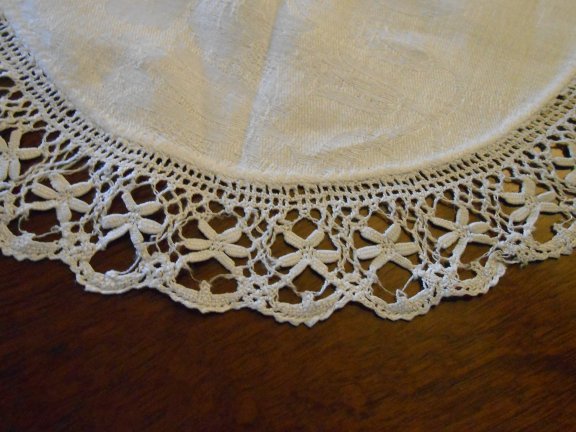
They recently got back from a trip to the Mediterranean where, knowing I love bobbin lace, she picked up this hankie:
Isn't that lovely?
Don't I have a good friend?
I've been asked by the Prairie Weaver's Guild in Springfield to do a beginning bobbin lace class the first weekend of March. Since this will be my first time teaching this craft, I'm a little bit nervous and a whole lot excited!
I've even arranged to do a 2-part class in the fall at Lincoln Land Community College. One week will be an introduction to bobbin lace (one evening) and the next week will be an introduction to Teneriffe Lace. I hope it catches people's imagination because I think it will be a fun introduction to both of these antique lace techniques. If you're in the Springfield area, be sure to watch out for the LLCC catalogue that will be out in March.
Knitting and more...spinning, beading, crochet, tatting, bobbin lace, tambour, watercolor....
Monday, January 28, 2013
I love it when my friends travel
Sunday, January 6, 2013
Starting New with Old
For as long as I can remember, I've wanted a crocheted bedspread. My mother thinks I'm crazy because they tend to be heavy and cumbersome but the heart wants what the heart wants. I've had it in the back of my mind just waiting for the right pattern to present itself. That finally happened as I visited an antique shop in northern Oklahoma on my way home.
This pattern, which is a very traditional bobble pattern is so pretty I can hardly stand it. I have a couple of cones of 10/2 cotton that I'm hoping will be enough to finish the spread. The original pattern called for a much thicker yarn but this finer thread is both more what I want and material I can use for other projects should I have any left over. I'm halfway through the second block. It's going very quickly indeed.
Do you have anything you've always wanted to make but haven't found exactly what you wanted to use to make it?
Here's something else I've been working on. This is a Teneriffe Lace medallion made with size 20 black crochet cotton. One of my (many) next projects is going to be a scarf made out of Teneriffe lace. So lovely and sooooo easy.
This pattern, which is a very traditional bobble pattern is so pretty I can hardly stand it. I have a couple of cones of 10/2 cotton that I'm hoping will be enough to finish the spread. The original pattern called for a much thicker yarn but this finer thread is both more what I want and material I can use for other projects should I have any left over. I'm halfway through the second block. It's going very quickly indeed.
Do you have anything you've always wanted to make but haven't found exactly what you wanted to use to make it?
Here's something else I've been working on. This is a Teneriffe Lace medallion made with size 20 black crochet cotton. One of my (many) next projects is going to be a scarf made out of Teneriffe lace. So lovely and sooooo easy.
Saturday, December 8, 2012
Treasure Hunt
I've had the most extraordinary antique mall visits lately. I regularly make the rounds of the many around Springfield and whenever I'm out traveling but rarely find much. I just enjoy the hunt. Usually I'm looking for tatting shuttles (which I find from time to time), vintage craft magazines (which I find a little more often - I now carry a list of what I have so as to not end up with duplicates), lace bobbins (never found), and interesting textiles. Up until recently the last category has been very few and far between.
Then I found this:
It's a linen doily with a bobbin lace edge. Obviously there is some damage but I realized that I knew how to do all the various elements and so I decided to try to recreate the pricking from the doily and see if I could work the edging.
The next week, I found a stall full of textiles. The first thing I picked up was this:
I've been getting more and more fascinated by the needle laces that were so common in the period and these magazines have a lot of instructions for these. I'm still delving into the Teneriffe Lace but I'm also fascinated by the drawn work.
Again, this one has some damage but it's exquisitely worked and I can't stop looking at it, trying to figure out how it was all done. Jiminy cricket, it's beautiful.
I also found several examples (of varying quality) of Battenburg lace and cutwork.
Then I found this:
It's a linen doily with a bobbin lace edge. Obviously there is some damage but I realized that I knew how to do all the various elements and so I decided to try to recreate the pricking from the doily and see if I could work the edging.
The next week, I found a stall full of textiles. The first thing I picked up was this:
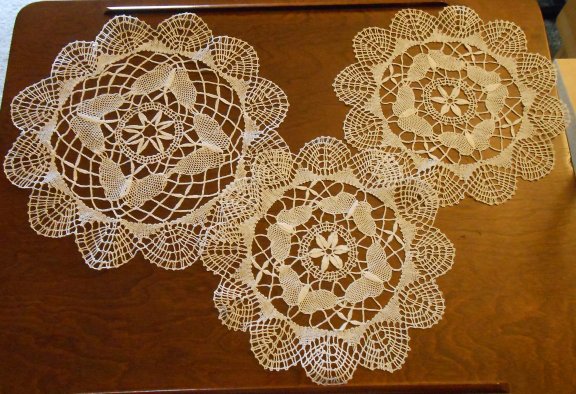
A bobbin lace doily with, yes, butterflies creatively worked into the pattern. It was worked with a thread that was a little too fine for the pattern.
Detail of the butterfly.
Then I picked up...
a packet with 2 more doilies of the same pattern! These were each done with a different thread and, as you can see from the detail shot above, the slightly heavier thread fills out the pattern a little more. Also, the center holes were more neatly done. Practice makes perfect?
How fun is that to have the document of someone trying out a pattern with different threads to get the right one for the pattern! I can certainly so all the techniques in this one so I'm going to work this weekend on getting the pattern pricked from the nicest of the doilies. I think I've got the number of bobbins figured out and know how to start the work. Maybe over the Christmas break I'll have the quiet time to get it started, at least.
But that's not all!
The last few weeks I've been working on documenting the vintage and antique craft magazines in my collection, especially focusing on the Needlecraft and Modern Priscilla issues. Because most date back to the 1910-1939 time period, I wanted to minimize wear and tear but still be able to get to the articles and patterns, I've created a spreadsheet with the month and year and a note of each of the patterns or articles in each. It's fun to see how different crafts came into and then fell out of fashion over the years.
Lo and behold, what did I find?
Again, this one has some damage but it's exquisitely worked and I can't stop looking at it, trying to figure out how it was all done. Jiminy cricket, it's beautiful.
But that's not all!
I also found several examples (of varying quality) of Battenburg lace and cutwork.
I'll let you know what I come up with!
Labels:
antique mall finds,
battenburg lace,
bobbin lace,
cutwork,
drawn work
Thursday, November 22, 2012
Thanksgiving Day - Heritage of Crafters
In documenting the patterns in my vintage magazines, I came across the following article. It was first published in the November 1931 issue of Needlecraft - The Magazine of Home Arts and traces the history of the woman who is almost singlehandedly responsible for the annual celebration of a Day of Thanks, the only pure holiday left to us.
Why Thanksgiving Day is Perennial – A Quilt Expert Tells the Story of Sarah Hale
By Florence Yoder Wilson
An interviewer has to be adaptable. Able to change at the slightest breath. For instance, take the visit made to Ruth E
Finley, of quilt fame. I went to find
out about quilts and came back with a Thanksgiving story that was so good that
it became THE story, and both Mrs. Finley and the quilts and her lovely home
all have to take a back seat this November whilst Sarah Josepha Hale, for fifty
years editor of Godey’s Lady’s Book, proudly marches through these pages and
receives from each reader’s heart the applause long due her for putting
Thanksgiving Day on the map, or more strictly speaking, in the calendar.
True I shall not neglect Mrs. Finley, either on persona,
quilt, or Sara Josepha scores. For it is
she and no other who held me fascinated that torrid August day in Hempstead,
Long Island, she who is responsible for the best book on quilts to be had,
namely, “Old Patchwork Quilts and the Women Who Made Them,” and she who, in the
course of her research on coverlids, met, and fell in love with Sarah Josepha
Hale.
That love was no flash and disappear affair. It developed into an absorbing passion,
burned steadily for several years, and at last has blazed forth into another
book by Mrs. Finley entitled “The Lady of Godey’s, Sarah Josepha Hale”
(published by J.B. Lippincott Co, Philadelphia, PA), which is just in print
this winter.
Mrs. Finley found Mrs. Hale while she was looking up quilt
patterns for her quilt book, in the old files of Godey’s Lady’s Book. Everyone whose grandparents, or even mothers
and fathers, were born in this country must have at least a memory of this
first woman’s magazine.
Reproductions of Godey’s colored plates of ladies’ fashions
appear everywhere now, pasted on lamps, books, toilet boxes, match boxes and
what not. The age of hoops, and
flounces, and delicate fainting females, is not likely to be forgotten,
especially at the present time. The
little Eugenie hats, so popular this winter, are of that very precious period. But whether you know Godey’s or not here’s
Sarah Hale’s story, retold in my words, as Mrs. Finley told it to me.
Sarah Josepha Hale is to be reckoned as one of America’s
foremost women for many reasons, but just at this time, her distinction as being
the person responsible for Thanksgiving Day as we celebrate it, in unison, as a
nation, is by far the most appropriate matter to discuss.
For thirty years, this indefatigable woman wrote to
different presidents, the governors of states and territories, and to men and
women in public life urging them to consider the value of a national
Thanksgiving Day, proclaimed yearly a holiday by the government.
In the beginning as we all know, the first proclamation for
a Day of Thanks was made by General Washington in 1789. It is not so well known, however, that,
following this time, there was no special date set for such a demonstration of
gratitude to God for His mercies. Each
year, at variable dates, it was the habit for people to meet and keep a Day of
Thanks. Certain localities observed the
custom regularly especially in the New England states, but all over the south
and west, this occasion was sometimes celebrated, and sometimes not. In any
event the dates varied greatly, and there was no national celebration of any
kind.
Sarah Hale had an idea that a national holiday would unify
the country, and draw it together in common bonds of prayer and gratitude. It is hard for us to realize today, what this
far-flung nation was before the Civil War.
Gravest doubts as to our ever being able to act as a unit assailed the
most patriotic. This state was like a
European sovereignty, that state was tied up with two or three others, and
seemed to have no identity; the west was divided into territories, and the far
west was at best a grave hazard, against which the hardy forty-niners had
thrown themselves, said some, in vain.
The deepest instincts of patriotism stirred Mrs. Hale to her
thirty years’ endeavor. But for her, Thanksgiving
would have disappeared, or become merely a sectional holiday indulged in by a
few New England states.
In 1863 Abraham Lincoln, acceding to Mrs. Hale’s earnest
solicitations issued a Thanksgiving Day proclamation, and in the
administrations following the custom has never been dropped. Who was this Sarah Hale? Oh, just one of our early school teachers, to
begin with. The kind that brushed the
rattlesnakes off the front stoop before they went into the little red
schoolhouse, and at lunch with the smallest children for fear the mountain
lions would make their lunch of them.
School-teaching lasted seven years, and then came marriage,
to David Hale, at twenty-five, and life began at Newport, New Hampshire. Four children were born to the Hales and two
weeks before the fifth child was born, Mr. Hale died, leaving his wife
destitute – with five children to support and educate.
That word destitute has the same spelling it had back in
1826, but it hasn’t the same application and meaning. Destitute in those days was destitute. Sarah Josepha Hale had nothing, and no
prospects. Women did practically no
public work in those days. She tried millinery,
and failed.
She wrote a book of poems, which was published. Then she wrote a book called “Northwood,”
which was also published. Mrs. Finley
says it is the first American novel by a woman, with something of the
atmosphere of “Wuthering Heights” about it and that it has never been given its
just due. (Incidentally, I have never
read it. Will anyone owning a copy of “Northwood”
by Sarah Josepha Hale, please communicate with me at once?) And “Mary Had a
Little Lamb” – Everybody knows that poem.
Well, Sarah Hale is the author of that, too.
In January 1828, Mrs. Hale was made editor of the first real
woman’s magazine ever published in this country. The American Lady’s Magazine. In 1837 Louis G Godey who had started a magazine
of his own, tried to lure Sarah Josepha from her job, to be editor of his
publication. But she would have none of
him, and so he bought the American Lady’s Magazine and consolidated it with Godey’s
Lady’s Book, thereby automatically falling heir to Sarah Josepha.
Even Mr. Godey knew a real person when he saw one. If you want to meet the lady more intimately,
look for her in Ruth Finley’s new book, “The Lady of Godey’s.” For fifty years Sarah Josepha Hale, was an
editor and blazed more than one trail down which hundreds of American women
walk to this day.
Monday, November 19, 2012
It's all about the journey
I have no idea why I ever wanted to do bobbin lace. I'd never seen anyone do it and knew nothing about it. But it's opened up my interest into other types of laces, particularly needle laces.
The latest experiment is Teneriffe Lace. It's a needle lace that is worked in medalians then, typically sewn to the ends of a doily or to a garment for embellishment.
Tools are simple: a small, fairly firm pillow; a long, large-eye needle; thread; long glass-head pins
Then you wind the thread and start working. Here's a little part of my journey to Teneriffe...
The latest experiment is Teneriffe Lace. It's a needle lace that is worked in medalians then, typically sewn to the ends of a doily or to a garment for embellishment.
Tools are simple: a small, fairly firm pillow; a long, large-eye needle; thread; long glass-head pins
Then you wind the thread and start working. Here's a little part of my journey to Teneriffe...
Friday, November 16, 2012
Still here
Life goes on, right? That's all I'm saying.
Tuesday night I did my first program on bobbin lace making. The Prairie Weavers group asked me to give an overview of bobbin lace history and I thought I'd do a little practical hands-on as well. I love doing programs for this group, they're always so involved in the programs and ask great questions. I had a look at the tools for lace making like the various pillows and types of bobbins and then the types of lace made all over the world.
While I was preparing for the program, I thought I would do this little bookmark pattern as a sample.
When I was at the Vogue Knitting event in Chicago last month, I visited the Habu booth because I thought I might find some interesting yarn to use for bobbin lace. I came away with a silk/stainless steel and a linen/stainless steel and a 100% ramie yarn. With lace, you need a yarn/thread that will have some structure to it, which is why linen thread is so often used.
I tried the linen/stainless steel but it didn't work. Too rough. But then I did this pattern with the silk/stainless steel and I LOVED it! It's going to work great!
Tuesday night I did my first program on bobbin lace making. The Prairie Weavers group asked me to give an overview of bobbin lace history and I thought I'd do a little practical hands-on as well. I love doing programs for this group, they're always so involved in the programs and ask great questions. I had a look at the tools for lace making like the various pillows and types of bobbins and then the types of lace made all over the world.
While I was preparing for the program, I thought I would do this little bookmark pattern as a sample.
When I was at the Vogue Knitting event in Chicago last month, I visited the Habu booth because I thought I might find some interesting yarn to use for bobbin lace. I came away with a silk/stainless steel and a linen/stainless steel and a 100% ramie yarn. With lace, you need a yarn/thread that will have some structure to it, which is why linen thread is so often used.
I tried the linen/stainless steel but it didn't work. Too rough. But then I did this pattern with the silk/stainless steel and I LOVED it! It's going to work great!
Thursday, October 11, 2012
Meet the newest addition
I wanted to introduce the newest addition to my family. This is my Harrisville loom I brought home yesterday. It has a 36" weaving width and it's so beautiful. It was owned by my new friend, Darlene, who got it back in the early 80's. She decided that grandkids were more fun than weaving (and who could argue with that?) so it has gone unused for a number of years.
I already have some perle cotton pulled out to start winding the warp and I'll get Laurie to help me get that first warp on. I can hardly wait except I'll be out of town for a week or so. So I will wait but I'll be busily planning for my return!
I think I'm finally going to become a weaver.
I already have some perle cotton pulled out to start winding the warp and I'll get Laurie to help me get that first warp on. I can hardly wait except I'll be out of town for a week or so. So I will wait but I'll be busily planning for my return!
I think I'm finally going to become a weaver.
Subscribe to:
Posts (Atom)