Saturday, February 1, 2014

Can't Stop

 I just can’t stop starting new lace projects.  Two of them have been on the list for a long time and one just popped out a couple of nights ago.

A little over a year ago I got hold of a Spanish lace magazine called, La Encajera.  In it was a pattern for a bobbin lace fan.  It was really beautiful but it was also composed of elements that I knew how to do – individually, at least.  The challenge with it was that there were absolutely no instructions.  There was the pricking and a good photo but no clues as to how many pairs of bobbins, not to mention how to hang them, start off or anything else.  For a long time, I knew it was beyond my skills so I prepared the pricking, ordered the thread and waited for the right time.

It seems to be the right time now so I shrunk the pricking to match the thread I wanted to use (a nice linen thread) and got everything started.  If I just work slowly and pay close attention to how each element interacts with its neighbor, I should be okay.  I’ve only had to take out part of it twice so I think this is pretty good progress.

The second project was one I thought about last summer as I was in the process of buying the house.  I wanted something of my Glasgow heritage to be represented in the house but wasn’t sure how I wanted to do it.  After I did the Victorian Lady piece for Jane, I realized that this was the perfect style to work a piece based on the symbols and emblems that make up the coat of arms of Glasgow. 
 
All based on:

 There’s the tree that never grew,

There’s the bird that never flew,

There’s the fish that never swam,

There’s the bell that never rang.

 All of these are based in legends that you can read about hereI took my representation from a photo of light post found in the city.

I’ve started but am prepared to go through a bit of trial and error to make sure to get something that will take pride of place over the mantle.

Finally, I had a crazy idea a couple of nights ago.  I had brought up a handspun skein of yarn from the basement that I was trying to decide what it wanted to be.  I had a lot of fun spinning it but I only had 1 skein of chunky yarn that wasn’t super soft and I wasn’t sure what to do with it.  I’d brought it up and dug out some needles, assuming I would be knitting something.

Who knows how these things happen but I looked at it and thought, “I wonder if I could use this to lace a scarf?”  Sure I could but how would I do it.  Although it was pretty chunky, I felt it needed a little more bulk so I decided to crochet a looooooong chain and use that for the lacing.  So I made a base and then crocheted 6 pairs of chains.  At first I thought I would need more but after thinking about it a little, I decided that any more would make it too bulky so I left it at that. 
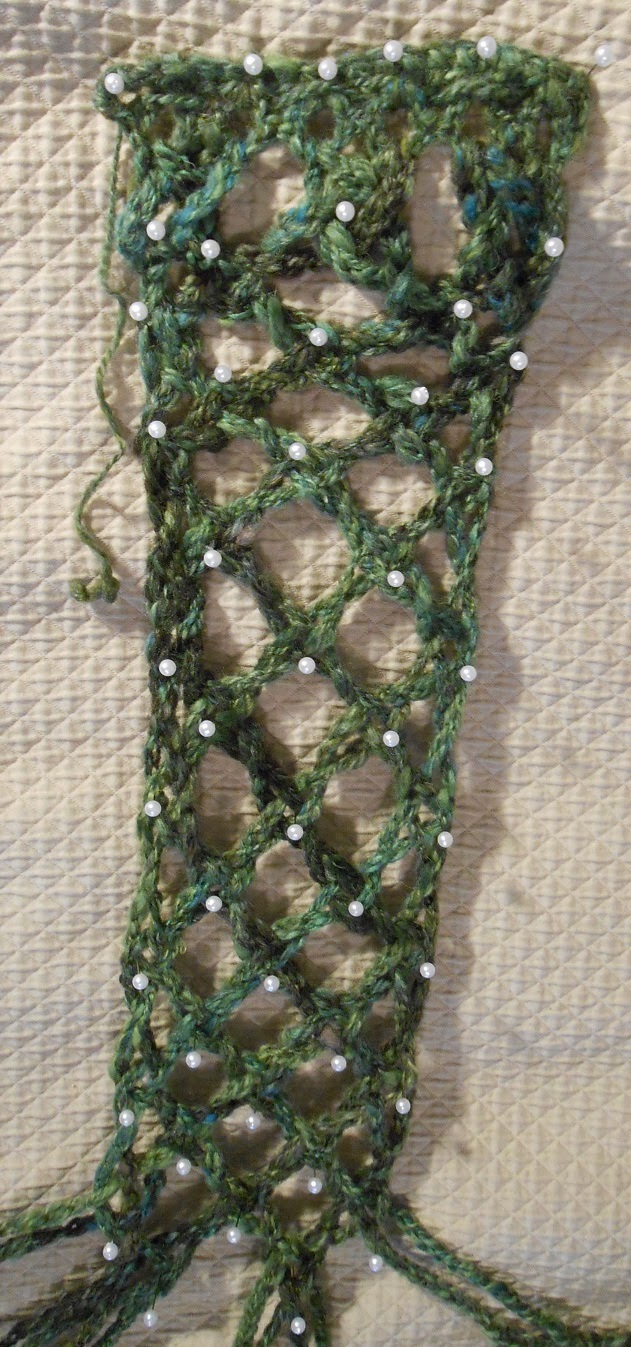

A couple of unknowns were:
  • How long should I make each chain?  I just made them long and tried to make them roughly the same length.  When I finished the chain, I only loosely bound it off – I figured I would need to adjust the length at the end of the day.  Actually, I was pretty sure I would need to add to the length (I didn’t) but this would work either way – to lengthen or shorten.
  •  Where would I do the lacing?  I wasn’t going to make an actual pricking so I thought the bed would be plenty long for working it.  It was enough but not plenty.  When I reached the end of the bed, I finished.  Plus I had only 1 of my large pins left.  It was long enough.
  • How would I finish it off at the end?  I ended up making a similar placket to what I’d begun with and tied the chains onto it.  The yarn ends were worked in with a needle but it needed more.  I decided to go with a plaited fringe.  I think it needs some large beads added to the fringe area but I didn’t have what I wanted on hand and it’s a freezing sheet of ice on the roads outside.  Beads can always be added later.
 
It was a fun project and gave me tons of ideas for some funky projects I could work in a similar manner. 

Sunday, January 26, 2014

Flax to Linen


I’ve just finished spinning a bunch of flax for a friend of mine.  The flax had belonged to a dear friend of hers who passed away.  She didn’t want a very fine thread because she wanted to use it in her knitting but the fiber was fairly coarse anyway so it was spun “rustically.”  That’s my way of saying that I didn’t know what the heck I was doing but had a great reference book to guide me and I learned a few things.  Linen Hand Spinning and Weaving by Patricia Baines was my introduction to this challenging fiber.
Here are a few of things I learning in this process, which, by the way, took me about 2 years to do – 1 ½ years sitting staring at me from its perch on one of my stash piles and 6 months of starting in the summer when it could be done on the back porch and then putting it off for another 5 ½ months because it took a lot of concentration).  All in all, it was probably about 6 hours of spinning. 

  1. Learning to dress the distaff correctly is critical.  If it the distaff isn’t correctly dressed, it can either be too dense to draft well or too loose, making it hard to draw in the right amount of fiber.  Learned by experience as well as by reference to the book.
  2. Flax shouldn’t be spun in the living room unless you have a couple of hours to dust, mop and vacuum after you’re done.  If you’re spinning on carpet, by all means, lay a sheet or cloth beneath your entire work area.  Flax is messy.  It’s like hanging out with a bunch of grass clippings, which it sorta is, if you think about it.  If you have people in your house with allergies, I strongly recommend spinning this fiber outside.
  3. When spinning flax, be prepared to pamper your wheel.   Make sure that it’s well-oiled throughout the process and that you clean it thoroughly after you’re finished.  You’ll most likely be spinning on a very high ratio which means your wheel needs lots of oil to handle the very fast moving parts.  Reasons for the cleaning, refer to #2.
  4. Patricia Baines says that the tradition (and the innate desire of the flax fibers) is to spin S singles and Z ply although she does stress that if you’re going to weave with your thread, there’s not a need to ply it.
  5. You should keep a pot of warm water or a sponge wetted with warm water by your side because water makes flax stronger and makes it possible to spin a smoother yarn or thread.
  6. It makes your hands smell very fresh.
  7. It’s very difficult to find well prepared flax although I did located some through The Woolery in Kentucky.  But it was backordered for about 6 months before I received it.
  8. Ms. Baines recommendation to treadle very slowly is very good advice.
I have an ambition to spin some flax finely and evenly enough to use it for a piece of bobbin lace, which is the traditional fiber used for the craft.  Check back in another 2 years and I might be close to giving it a go! 

Wednesday, January 22, 2014

Frog in Snow

I had to laugh this morning when I looked out the bedroom window into the back yard and saw this.
This little guy is sitting on a bird bath that used to sit in my garden.  It got knocked down during one of the storms but he's patiently waiting for spring.

Monday, January 20, 2014

Fini

I love it when projects go like this one did. 
 
Way back last year, early last year, I bought some fiber.  It was a special deal from Ashland Bay that had a variety of unusual wool fibers, including "Portuguese" wool and Masham (a breed of sheep).  I had some dark chocolate Shetland (another breed of sheep) in my stash already so that gave me a natural white (Portuguese), medium grayish brown (Masham), and dark brown (Shetland).  Several years ago I'd used the Ashland Bay Apple Green to spin some yarn for mittens and a scarf and I loved the color.  I thought that would be a great pop of color to go with the natural colors so I got some of that as well.  Late last year on my trip to Maine, I got to go to Halcyon Yarns (one of my absolute favorite places in the universe) and while I was there I found a Merino (yet another sheep breed) mix of 3 shades of natural colors that you spin together and get a medium brown with good depth to it.
 I started spinning a nice fluffy 2-ply yarn that after washing ended up much thicker than I expected.  But I had a picture in my mind of what a Fair Isle sweater would look like using these yarns.  Just a picture.  But I realized that the yarn was really too chunky for a sweater and I spent much of my drive to my Mom's mulling over what to do.  Lo and behold, I came across a knitting book in an antique mall that showed a cabled poncho using thick yarn and it hit me.  That would be a perfect use for my lovely yarn.
 I chose my needles and number of stitches to cast on (based on the cabled poncho pattern) and started out.  Actually first of all, knit a swatch using all the colors and decided that was how I wanted to start off.  And then I carried on.  I decided that, because of the chunky yarn, I should use smaller motif designs.  With my handy pattern dictionary at my side, I looked through, found a few that I liked, decided the order of them and I knit.  Once I got to the next section and it seemed like it was time for another one, I chose and knit another one and so on.
Once I got to the shoulders, I wasn't really sure how to do the decreases so I just winged it and it came out perfectly.  So how does one finish it off?  With a wide fold-over pivot edged collar.  The collar done like that made room for the button bands and finished it off just right (as did the heavy shell vintage buttons that I already had on hand - just right).        

Tuesday, January 14, 2014

I forgot to show you this...

 
This was my mother's Christmas present. She's a Texas Master Naturalist so when I saw this pattern, I knew it would be perfect for her. 
 
The problem was that when I went home for Christmas, it wasn't finished.  I don't know if you've ever tried to work a bobbin lace piece in stealth mode but it ain't easy, I can tell you.  So Santa's little elf had to hide herself away a few times to get it all done.  But Mom seemed happy with it and I was happy with it so I guess you can't ask for much more. 

Monday, January 13, 2014

Pilgrim's Progress

It's been a while but lest you think I haven't been doing anything, here are some things I have going.

Headbands
A couple of years ago, one of my co-workers asked me to make her some warmy, cozy headbands, which I did.  She's worn them each winter since and this year several of her friends decided they wanted one.


They're both ccrocheted  One has a rosy flower and the other has a more stylized flower and needs a button yet put on in the center of it to finish it off.  I just need to get up to the attic to rummage through the buttons.

Back behind the headbands, you'll see that I've got some bobbin lace bobbins loaded up with a golden sunshine of a linen thread and ready to start the new project.  It's going to be a fan from a Spanish magazine.
                             

Here's the start of it.  I've put this project off because it didn't come with instructions and I wanted to wait until I felt I had the skills to attempt it.  I think I'm pretty much there although I don't want to be too braggy until I actually get it started and end up with the right number of bobbins and those in the right place!

The real progress of this pilgrim, however, is with my fair isle poncho.  You know, the one I've been spinning yarn for and plotting for a while.  I finally got the inspiration  this weekend and started going to town on it.  (For "going to town" read "obsessing".)


I am completely thrilled with how it's coming along and how the colors are interacting.  The fair isle pattern takes on a completely different look in the chunky yarn.  Now I just need to figure out how I want to shape the shoulders and draw in the neck line and I should be close to being done.  It will need a button band in the front and I'm mulling over how wide I want it to be and what I want it to look like.  I've got some ideas but I need to mull them over a little bit more before I talk about them. 

I very seldom knit with large needles (I'm using US size 8 for this project - very large for me) or chunky yarn and this project has 200 stitches.  Now that I'm doing it, I realize why I don't do it very often.  It's much harder to pick up any speed.  Yes, you have larger stitches and so are probably making progress much faster than you realize but the fact that I have to stop ever 5-6 stitches to move them along the needle where they won't bunch up and stop me in my tracks make it feel like a realllllly sloooooow process.

But once I'm done and get it blocked, I think it's going to be the go-to cover for many years to come.  And all conceived and spun and contrived and designed and knit with me own wee handiest.  For me, that's what it's all about.

By the way, I did the poncho because I didn't think I would have enough yarn for a sweater but now that I'm closing in on the finish line, I totally would have had enough for a sweater.  But, as always, go with the wisdom of the wool.  I wouldn't have thought of a poncho but now I'm in love with it and so glad the wool wanted to be a poncho.  So the moral of the story is: Never doubt the wool.

Sunday, December 22, 2013

For Mom

My mother hinted the other day that she was tired of seeing the same post so I figured it was time to pull my socks (handknit, of course) up and get something posted.

Actually this post carries on from the last post.  I have done a number of other projects since the last post, way, way, way, long ago, but I can't show all of them because some are gifts and some because of other reasons.

But for this post, I show this:
This is a sample knit from the various yarns I've spun for my fair isle sweater which is no longer going to be a sweater.  I've decided that it's going to be a poncho so I can #1 - know that I have enough yarn (I don't think I have enough for a sweater and while I have more off the green and chocolate brown, I've spun all the fiber I had in the other colors) and #2 - better show off the bulky yarn.

Yes, the yarn came out a little bulkier than I'd originally anticipated but that's okay.  It's going to be cozy warm and I really like the idea of having more use out of it as a poncho than I might have had with a sweater.  I think, too, as a poncho, it won't have as much wear and tear, with accompanying pilling, as it might as a sweater.

That's what I've told myself anyway.

The plan as it stands right now is to do a wide border similar to this sample, then a large band of fair isle and then this sort of striping around the neck.